|
Lieutenant Commander Lawrence A. Marsden,
USN (ret.) was commission an ensign the United States Navy, in 1942. He “graduated from Navy Supply Corps School August
of 1942 and was ordered to duty at the Motor Torpedo Boat Commissioning Detail in New Orleans, La. Believing that the war
might last for years, he transferred from the Naval Reserve to the Regular Navy; and, was promoted to Lieutenant Junior Grade;
and, then to Lieutenant. Following this last promotion was ordered to duty as Supply Officer aboard the USS Doyen (APA-1).
He reported aboard in early May of 1944, prior to the invasion of Saipan and served through the landings
at Saipan, Guam, Leyte Gulf, Luzon and Iwo Jima.” After the war, he was admitted to the Bar and resigned his Naval Commission.
He has published three versions of essentially the same memoir. Two of them are, Attack Transport: The
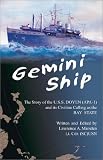
Story of The USS Doyen and Gemini Ship: The Story of the U.S.S. Doyen (APA-1) and its Civilian Calling
as the Bay State.
The MOAA said of Gemini
Ship: The Story of the U.S.S. Doyen (APA-1) and its Civilian Calling as the Bay State, “During WWII, the
U.S.S. Doyen (APA-1) voyaged more than 100,000 miles participating in many Pacific battles including bloody Saipan and Iwo
Jima. Its crew and passengers were members of the U.S. Navy, Marine Corps, and the Army. In retelling his first work, Attack
Transport, Marsden captures what the men of the Doyen saw and felt from loneliness and boredom to the horror and waste of
war. Avoiding the scrap yard after the war, the Doyen was resurrected to duty from 1957 through 1972. It served as training
vessel, dormitory, classroom, and cruise ship for the Massachusetts Maritime Academy in Buzzards Bay, Mass. With a new crew,
a new mission, and a new name, the Bay State now carried boisterous and carefree midshipmen who were a striking contrast to
the crew of the Doyen, but many of their experiences ended up being quite similar. Revel in their stories as the Bay State
carried them to the oceans of the world.
|
|
 |
|
One reader of the earlier work said,
“Lawrence Marsden does a great job of recalling emotions, anecdotes, and observations from the holds to the gun turrets
to the bridge of the U.S.S Doyen throughout WWII in the Pacific. What better way to get the feel of what it was like off Leyte,
Luzon, Iwo Jima, and a hundred other landings during those dark years. This one is a must for WWII history buffs and for serious
students of the Pacific Theater. Attack Transports such as the Doyen often got in close and often stayed in close to the beaches
where their crews could observe the initial phases of the battle taking place on shore. Their observations can add much to
the historical accuracy of these events.”
|
|
|
|
|