|
After his discharge Lee Ballenger began his law enforcement
career with the Los Angeles County Sheriff’s Department. He retired in 1989 at the rank of Lieutenant. Lee
Ballenger is the author of a two volume set on the Korean War: The Outpost War: U.S. Marine Corps in Korea, 1952 and The Final
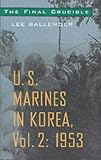
Crucible: U.S. Marines in Korea, 1953.
According to David Alperstein of Library Journal, “In
his first book, Ballenger succeeds in presenting a lucid account of the 1st Marine Division in western Korea in 1952, a period
of the war (June 1950-July 1953) he describes as a "stalemate" while also pointing out that 40 percent of all Marine
casualties occurred after April 1952. Ballenger argues that this period is ignored by historians. This book is actually the
first of a two-part set whose second volume will cover 1953 and the final bloody months of the war. The author uses the personal
experiences and insights he gained while serving in the 1st Division Reconnaissance Company and the 1st Tank Battalion as
well as his battalion command diaries and other sources to write a concise, readable study of what he calls the "Unknown
War." The tactics and strategies used by the Marines, Chinese, and Korean (North and South) are described and analyzed.
The appendixes provide a detailed list of the many hills, outposts, and military sites relevant to the 1st Division's story.
The book is not meant to be a detailed historical study, but it is an intelligent look at one phase of the Korean War. Recommended
for public and academic libraries, this will be of special interest to veterans and military history buffs.”
|
|
 |
|
According to Roland Green, in Booklist, “In his
second volume on marine operations during the Korean War's last years, Ballenger continues to be a military historian equally
useful to the scholar and the casual buff. The fighting centered on outposts, as each side sought to obtain the best positions
to influence the peace negotiations through numerous small operations, occasional larger ones, and many raids, patrols, and
outbursts of harassing fire. Highlighted in this volume are one of the largest raids, of Ungok; the bloody ambush at Gray
Rock; the long fight for a complex of outposts named after Nevada cities; and the worst battle of 1953, for Boulder City--the
last marine engagement in Korea. Lee Ballenger continues to provide model accounts of small-unit actions, to enlighten readers
on the value of tanks in infantry support (a high-velocity tank gun is good backup), and to be none too charitable toward
what is described as the army's tendency to leave the marines holding the bag. Like its companion, The Outpost War (2000),
this is a nearly indispensable Korean War history”
|
|
|
|
|