|
According to the Los Angeles Police
Department, “William J. Bratton was appointed Chief of the Los Angeles Police Department in October 2002.
Chief Bratton oversees the third largest police department in the United States, managing 9,300 sworn officers, 3,000
civilian employees, and an annual budget of more than one billion dollars. A strong community policing
advocate, he is directing a major reengineering of the LAPD, decentralizing the bureaucracy, strengthening local commands,
increasing responsiveness to community concerns, and developing strategies to counter gang-related crimes and the threat of
terrorism. During his first three years as Chief in Los Angeles, the LAPD has driven Part I crime down
26.4 percent, including a 25.5 percent reduction in homicide. The Department has also developed one of
the most comprehensive and effective counter-terrorism operations in the country.
The only person ever to serve as chief
executive of both the LAPD and the NYPD, Chief Bratton established an international reputation for reengineering police departments
and fighting crime in the 1990s. As Chief of the New York City Transit Police, Boston Police Commissioner,
then New York City Police Commissioner, he revitalized morale and cut crime in all three posts, achieving the largest crime
declines in New York City’s history. He led the development of COMPSTAT, the internationally acclaimed
command accountability metric system that uses computer-mapping technology and timely crime analysis to target emerging crime
patterns and coordinate police response. From 1996 on, Chief Bratton worked in the private sector, where
he formed his own private consulting company, The Bratton Group, L.L.C., working on four continents, including extensive consulting
in South America. He also consulted with the Kroll Associates monitoring team overseeing the implementation
of the Federal Consent Decree with the LAPD.
A U.S. Army Vietnam veteran, Chief
Bratton began his policing career in 1970, as a police officer with the Boston Police Department, rising to Superintendent
of Police, the department’s highest sworn rank, in just ten years. In the 1980s, Chief Bratton headed
two other police agencies, the Massachusetts Bay Transportation Authority Police and the Massachusetts Metropolitan District
Commission Police.
Chief Bratton holds a Bachelor of Science
Degree in Law Enforcement from Boston State College/University of Massachusetts. He is a graduate of the
FBI National Executive Institute and was a Senior Executive Fellow at the John F. Kennedy School of Government at Harvard
University.”
William J. Bratton is the co-author
of Turnaround: How America's Top Cop Reversed the Crime Epidemic and Scene of the
Crime: Photographs from the LAPD Archive.
According to the book description of
Scene of the Crime: Photographs from the LAPD Archive, “Los Angeles in the decades after the
Depression was a smoldering powder keg of vice, corruption, violence, and some of the most sensational crimes in American
history. The Black Dahlia slaying, the Onion Field murder, film star Thelma Todd's mysterious death, the killing of Kansas
City gangsters "The Two Tonys" by Jimmy "The Weasel" Fratiano: these are but a few of the cases that once
riveted the nation's attention and were captured in striking crime-scene and forensic photographs for the Los Angeles
Police Department.
Long forgotten in a warehouse, these
recently discovered photographs from the LAPD archive form a powerful visual history of the underbelly of Los Angeles from
the 1930s to the 1960s. Although disquieting and often brutal, the images have an atmospheric, eerie beauty that belies their
documentary purpose. They are accompanied here by captions from police logs and original newspaper accounts, along with an
introduction by James Ellroy, the leading practitioner of the Los Angeles noir genre, and an essay by curator Tim B. Wride
discussing the archive's importance to social history and the history of photography. AUTHOR BIO: William J. Bratton is
the 55th chief of the Los Angeles Police Department and has also served as police commissioner for both the Boston and the
New York City police departments. James Ellroy's books include the international best-sellers The Black Dahlia, The Big
Nowhere, L.A. Confidential, White Jazz, and American Tabloid. Tim B. Wride is associate curator of photography at the Los
Angeles County Museum of Art.”
One reader of Scene of
the Crime: Photographs from the LAPD Archive said, “Scene of crime photos like other professional images
(medical, a racetrack photo-finish, IDs, speed cameras etc) don't need to worry about creative input, they just need to
give basic information, tell a story and that's it. The 133 case study photos in this handsomely designed and printed
book certainly captured my interest and I wanted to know more.
A t
this point the first problem arises,
all the captions are at the back of
the book, despite the fact that many
of the photos are on pages with plenty
of white space. At the back the photos
are presented as thumbnails but even
here it gets confusing, the captions
are in a separate text block to the
thumbnails. The reality is that all
the captions could easily be with the
relevant photos if the book had been
designed a bit differently or if the
captions had to be in the back they
should have been placed below the
relevant thumbnails.
There might be a reason for this rather
inadequate arrangement though because (problem two) there are sixty-five photos, which when you turn to read the caption,
you'll find the photo date, a one or two word description and then 'Case information unavailable'. So, amazingly,
for about half the photos in the book there are no captions, no story to tell. To my mind this seems a fairly fundamental
editorial failure especially considering that the LAPD archives probably contain over a million case photos and surely 133
could have been selected that had their case material available.
As to the photos, they are the usual
selection of battered and bloodied bodies in car wrecks, living rooms, bedrooms, eateries or just plain anywhere, ransom notes
(bank robbers are not a very literate bunch) mug shots and plenty showing the ordinary, mundane detritus of crime. Historically
they cover the twenties to the seventies and fortunately you'll find no celebrities here.
There seems to be a growing interest
in publishing crime photos, I have a copy of 'New York Noir' (ISBN 0847821722) a beautifully produced book of images
from the archives of the New York Daily News and the rather more crudely produced (and this probably gave the photos more
impetus) 'Death Scenes' (ISBN 0922915296) a very explicit collection of photos collected over the years by LA detective
Jack Huddleston.
'Scene of the Crime' is an
intriguing book that could have been far more interesting if it had delivered all that it promised, so only three stars. BTW,
if you are sensitive about photos of dead bodies don't buy it.”
|
|
 |
|
Amazon.com said of The
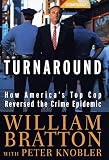
Turnaround: How America's Top Cop Reversed the Crime Epidemic, “When William Bratton was a year and
a half old, his mother caught him directing traffic in the street out front of their Boston home. From that moment on, it
seemed destined that he would become a cop. In this book, Bratton and his coauthor, Peter Knobler, chronicle Bratton's
career, focussing particularly on his efforts to revitalize Boston's and New York City's police departments. Bratton
rose quickly through the ranks of the Boston Police Department, where he pioneered community policing and cleaned up the city's
subway system. As New York's transit-police chief, he cracked down on minor offenses like turnstile jumping on the theory
that the people who commit more serious crimes underground also commit smaller ones. It worked. Finally, Bratton realized
his dream of becoming America's top cop: the New York City Police Commissioner. The city's crime rate dropped over
10 percent a year during Bratton's brief tenure as top cop, until Mayor Giuliani's administration forced him out of
the job in 1996.
In Turnaround, Bratton describes the
police initiatives that led to these successes. Bratton and his peers used computer mapping to pinpoint crime hot spots and
then cleaned up the areas using all the tools of law enforcement. One of the favored tools was "quality of life enforcement"--curtailing
minor crimes like panhandling, squeegeeing, and prostitution in order to make the streets seem less inviting to worse criminals.
Bratton made police commanders from all districts of the city accountable, requiring them to report on progress and problems
in their locales, during frequent departmental meetings. Bratton is now a consultant to police departments across the nation,
so, like it or not, his style of law enforcement may soon be coming to a city near you. This is not a page-turner or a masterful
work of literature, but Bratton's ideas about curbing crime should be of interest to both those involved in law enforcement
and regular people who are concerned about crime.”
One reader of The Turnaround:
How America's Top Cop Reversed the Crime Epidemic said, “I decided to read this book when Bill Bratton
was hired as Chief of Police in Los Angeles. This book reads like an autobiography, from Bratton's childhood in Boston,
until after his falling out with Guiliani. Through his experiences, I learned a lot about police work.
Critics say that Bratton's success
in New York was concurrent with a nationwide drop in crime (presumably due to a strong economy) and thus isn't such a
big deal. Cheap shot. This book explains how a well managed police effort absolutely has an effect on crime. Bratton has a
strong track record of accomplishment, turning around the MBTA Police (Massachusetts Bay Transit Authority), the Metropolitan
Police (now part of the Massachusetts State Police), the New York Transit Police, Boston Police, and NYPD.
Bratton believes in the Broken Windows
theory, i.e that acceptance of petty crime creates an environment that breeds more serious crime. (The slippery slope argument.)
He also believes in analysis of crime statistics, by location/time/etc. to determine how to deploy police resources: originally
pins on a map, eventually growing in to the famous CompStat.
Having lived in the Boston area for
many years, the references to different parts of the city where he worked, and to various people (Mayors, police officials,
etc.) made the book all the more interesting for me. Also, Bratton talks about a book called Your Police which he checked
out of the library as a boy; I remember checking that same book out of the library when I was around 8-years old. (Although
I've always had a strong interest in it, I didn't pursue a career in law enforcement.).
Bratton certainly has his work cut
out for him in Los Angeles. The LAPD has been plagued by scandal, inept leadership, and (not surprisingly) low morale and
high employee turnover. And crime is pervasive -- from reckless driving, littering and graffiti, to gang drive-by shootings.”
Another reader of The Turnaround:
How America's Top Cop Reversed the Crime Epidemic said, “I have been teaching college level police
management courses since 1976. I began to cite Bratton's tactics and leadership style in my lectures after he appeared
in TIME and predicted that his name will be in police text books in the near future along with other heavyweights. Sure enough,
in John Dempsey's "Introduction To Policing" (second edition) Bratton's COMPSTAT efforts are cited on pages
24-25. What is surprising to me are the negative reviews posted on this Amazon review section. They apparently have no clue
on the nature of social disorder fostered in the "Broken Window" syndrome embraced by Bratton and integrated into
his crime-specific targeting tactics of COMPSTAT. And yes crime did decrease in the nation during that period but that had
nothing to do with targeting the notorious "window wipers" and recently paroled ex-cons (read the book to learn
about these police tactics). I wonder if the negative reviewers are part of the traditional set that resisted needed change
in how police do business? But I respect Bratton for his leadership style. Talk to New York transit cops who got new radios,
Glocks and black leather jackets. Those little things mean a lot to street cops and that's what bonds them to their leaders.
And, after being on the job only for a few weeks, he goes into the NYPD precinct to personally supervise the arrest of the
cocaine cops then faced the cameras holding up the badges telling the city that the badge numbers will never be used again
forever. It is a leadership paradigm that others wish they had thought of first. Of course, his detractors will call it grandstanding.
If they know so much, how come they never got to be top cop of Boston, NYPD or LAPD?”
|
|
|
|
|