|
Colonel Jeffrey M. Freeman, USA
(ret.) “served the Army and Army Reserve for thirty-three years, rising from draftee to colonel. He spent about a third
of his military career in Washington, DC, including the last two years when he was recalled to active duty to assist in the
writing of The Joint Staff history of Operation Iraqi Freedom.” Colonel Jeffrey M. Freeman is the author of Duty
and Character; Wrong Enemy, Wrong War; and, Hannah’s Ghost and the Shed on the Mountain Road.
This is a novel written for people
who want to know more about the pressures, pitfalls, and dangers of military life. It is a prequel to “Wrong Enemy,
Wrong War.” According
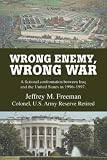
to the book synopsis of Wrong Enemy, Wrong War, “This military-political novel assumes that
someone other than Bill Clinton, or George Bush, was elected president in 1992 and re-elected in 1996. Two military systems
which were conceived but not developed play integral roles in the story. AIMS is a fictional name for an Army supply system
to replace the one used in the Gulf War. MICIS, also a fictional acronym, is a helmet-mounted, mini-camera system which was
supposed to give a ground commander a real-time look at the battlefield. In both cases, better systems were actually fielded.
The is a story of the often conflicting
motivations between the President, his appointed political advisors, and his senior military advisors who are charged to render
their best military advice to the commander-in-chief irrespective of personal consequences. t is also an intimate look at
the inter- and intra-Service relationships among generals and admirals. It provides a first hand look at how the Pentagon
operated in the early to mid 1990’s. The novel begins as Vice President
Bill Downing discusses getting access to Iraqi oil with a representative of a Texas oil conglomerate. Their golf game is interrupted
by news that Khobar Towers in Saudi Arabia has been attacked. It will become clear that the loss of American lives was the
work of Iranian backed Hezbollah, although some in the administration will try to connect the attack to Iraq.
Following his re-election, the President
is concerned with his historical legacy. He wants to be remembered as a man of peace and prosperity but the admonition that
it takes a war to make a great president nags at him. Saddam Hussein is still defying UN sanctions and probing America’s
willingness to maintain the no-fly zones. The intelligence community is divided as to his intentions. There are reasons to
believe Saddam may try to annex Kuwait again.
The President’s newest protégé
and Under Secretary of Defense, B. Charles Summers, pushes to eliminate Saddam any way possible. Believing Saddam to be a
threat to Israel and the US, Summers suggests assassinating Saddam, an idea that Army Chief of Staff General James MacDougall
regards as immoral and illegal. MacDougall favors continued sanctions and a blockade. When the Commandant of the Marine Corps,
General Creighton, suggests nuking Iraq, MacDougall voices concern that such action might set off nuclear retaliation by other
countries, which could have the unintended effect of creating nuclear winter.
The Commander of Central Command, General
Jimmy Plunkett; the Chief of Naval Operations, Admiral Storm; and General MacDougall are all in contention to become the next
Chairman of the Joint Chiefs of Staff. The Army’s chief logistician, Lieutenant General Bob Groves, who is a protégé
of General Plunkett and favored by Summers, wants MacDougall’s job. Professional misjudgments and personal indiscretions
add to the tensions. As the admirals and generals vie for power, they render anything but a unified opinion to the Secretary
of Defense and the President.
|
|
 |
|
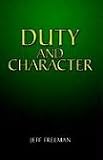
According to the book synopsis of Duty
and Character, “There are times when an officer must choose between what is right for the Service and
what is best for his or her own career. Like most lessons, integrity is often learned through a mistake. The mistakes of some
young officers from the social circles of Washington to the frozen training grounds of Alaska will prove costly. In Korea,
a wrong step could ignite a war. The Abrams M-1 tank wiped the Soviet’s best from the battle
field in Desert Storm. But the M-1 was almost never produced. Its critics and cost over-runs nearly buried it inside the Washington
beltway. Only because certain individuals were willing to risk their careers did the M-1 ever see combat. Duty and Character
uses a fictional but plausible M-1 fielding process. Twice in his Army career, Max Scott will face a test
of character when he encounters Cordellia Abbott. The first time will be painful. The second time, his career and the M-1
will hang in the balance.
This is a
sequel to Duty and Character. It was written for people who want to understand the complexities
of military life at the highest levels.” According to the book synopsis of Hannah’s
Ghost and the Shed on the Mountain Road, “Henry Styles is a middle-aged ad executive. His life and career
take some unexpected turns as he winds his way from Hartford, CT, to North Troy, Vermont, on what is supposed to be a rendezvous
with his much younger soon-to-be fiance. During an unplanned stop in Stowe, Henry encounters the ghost of a young bride-to-be,
who refuses to leave him. Henry will have only hours to solve the mystery of her attachment to him or risk losing his career
and his romance.”
|
|
|
|
|