|
Major Gene Baldwin, USAF (ret.) “received
his B.S. degree from Mississippi State University, his MBA degree from the University of Alabama. During these years he experienced
the last of the great depression, the frenzy of World War 2, and the naïveté of the 1950's.
Major Gene Baldwin joined the United
States Air Force in October 1950. His first assignment was as an Aviation Cadet, assigned to basic flight training at Perrin
Air Force Base, Sherman, Texas. He completed Air Force advanced flight training and received his pilot wings at Vance Air
Force Base, Oklahoma. Immediately after graduation, he completed jet transition at Moody Air Force Base in Valdosta, Georgia.
At Moody, he flew the Air Force's first operational jet fighter, soloing in the F-80 "Shooting Star." Following
jet transition he reported to all-weather intercept training at Tyndall Air Force Base, Florida. There, he checked out in
the F-94, the Air Force's first all-weather jet fighter. His orders, following training, took him to the 68th Fighter
Interceptor Squadron at Itazuke, Japan. This squadron had the distinction of downing the first communist aircraft in the Korean
war, flying the first interdiction missions of the war, and being the first all-weather jet squadron committed to combat.
Major Gene Baldwin spent twenty-five months in Korea and Japan flying missions as a fighter pilot during the Korean war.
When the Viet-Nam war was still in its initial phase,
Major Gene Baldwin served a short tour in Viet-Nam flying air assault missions in support of Special Forces. Operating out
of Danang, his unit was the primary support of all Special Forces and American advisors assigned to the ARVN forces in the
I Corps area. Other assignments in his twenty-one year career included tours of duty as Aide-de-Camp to the Commanding General
of the 20th Air Division; Assistant Professor of Aerospace Studies at Mississippi State University; Forward Air Controller
with the 82nd Airborne Division; and Air Force Liaison Officer and instructor with the United States Army Infantry School,
Fort Benning, Georgia. His final assignment was Base Executive Officer at Charleston Air Force Base, South Carolina
Following retirement from the Air Force,
Major Gene Baldwin was the Curriculum and Instructional Standards Director at the Navy Supply Corps School. As the Academic
Advisor with the Navy Supply Corps School, he developed and maintained training standards for twenty-seven courses taught
at the school. These courses included officer and enlisted courses, and courses for foreign officers. Major Gene Baldwin succeeded
in getting the school accredited with the Southern Association of Colleges and Schools. When measured against the required
standards for accreditation, it was the first military school to attain the distinction of full accreditation with no recommendations
made for improvements by the Commission on Occupational and Educational Institutions.
|
|
 |
|
While assigned as Air Force Liaison
Officer at Fort Benning, he wrote the Forward Air Controller Manual for the United States Army Infantry School, which was
adopted as an Infantry field manual for close air support of ground forces. Major Gene Baldwin has written curriculum for
training students in three different services; three articles published in professional journals; and several contributed
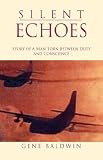
newspaper columns. Major Gene Baldwin is the author of Silent Echoes: Story of a Man Torn Between Duty and Conscience
and A Matter of Destiny.
According to the book description of
Silent Echoes: Story of a Man Torn Between Duty and Conscience, “This is the story of a young
Air Force pilot faced with an immediate deployment to Vietnam, leaving behind a troubled marriage. Confronted with a Machiavellian
Commanding Officer, the situation provides the young Flight Commander the determination to outwit military politics and ineffective
leadership. Silent Echoes puts the reader in the cockpit, deep in the jungles of Vietnam, and allows a birds-eye view into
the psyche of the aircrews who fly the missions. Not only does this tale delve into a man's inner personal struggles to
reconcile duty with integrity and conscience, the interwoven threads of struggling love propel the reader towards its dramatic
ending.”
According to the book description of
A Matter of Destiny, “This is the story of a man who falls in love three weeks before leaving
for flight training, the struggles of separation, and the Korean War -- all of which seem insurmountable odds for this young
couple.”
One reader of A Matter
of Destiny said, “Gene Baldwin writes a compelling story about love and the heartbreak of war- from leaving
your new found love to losing many of his close friends through the causalities of war. His words flow easily and when I finished
the book it was as though I had made a new friend who told a wonderfully interesting and exciting story to me. I do hope Gene
continues to write; he has a real talent for describing emotions and putting you "there", right in the midst of
what is happening.”
|
|
|
|
|